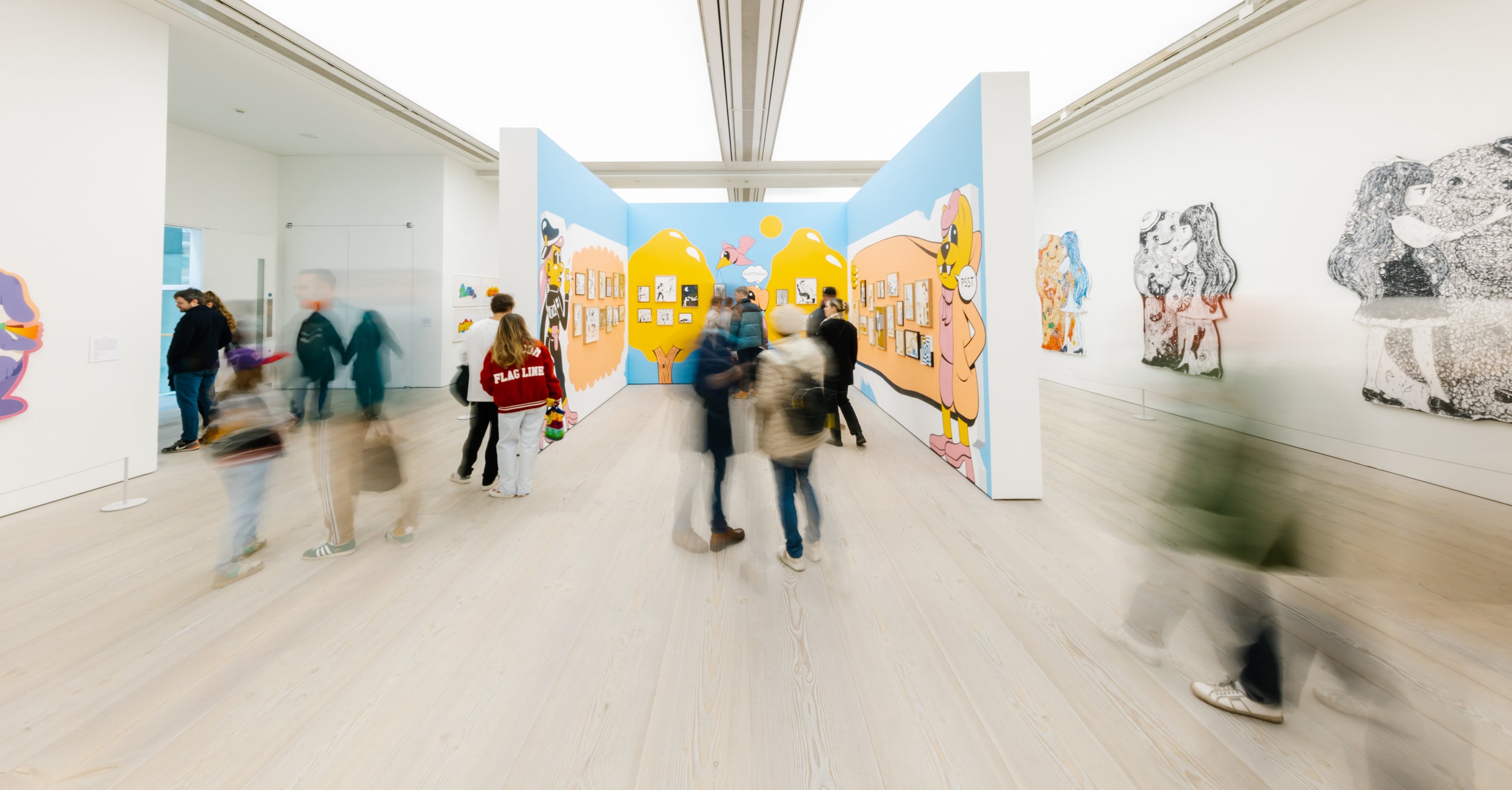
Les portes de BEYOND THE STREETS LONDON étant officiellement fermées, nous avons voulu revenir sur l’exposition et sur certaines des nombreuses salles qui ont contribué à raconter les histoires des artistes et des mouvements ayant façonné le monde du street art et du graffiti au cours des cinquante dernières années.
BEYOND THE STREETS LONDON rend hommage aux moments monumentaux de l’histoire du graffiti, du street art, du hip-hop et du punk rock, ainsi qu’aux artistes qui les ont immortalisés. De la peinture sur les trains à l’activisme social, en passant par les vêtements que nous portons et les bandes-son de nos vies, BEYOND THE STREETS LONDON investit l’intégralité de l’emblématique Saatchi Gallery et examine comment ces récits culturels ont fait évoluer la perception que le public avait de l’art et de la culture underground, donnant naissance à une révolution créative mondiale. À la fois éducative et divertissante, BEYOND THE STREETS LONDON célèbre l’essence même du graffiti : le désir inné de laisser une marque et de défier l’autorité. Par nature, le graffiti est éphémère ; son existence est temporaire, mais la culture et son esprit rebelle perdurent.
Une sélection d’œuvres de l’exposition disponibles à la vente peut être consultée ICI.

Le livre compagnon de BEYOND THE STREETS LONDON est désormais disponible dans notre boutique en ligne.


Trash Records
The birth of graffiti as we know it is also a convergence of culture like we have never seen before. Through social and political turmoil of the late 1960s, where urban decay met artistic resistance, a shift was felt in both the US and UK. Youth culture responded by painting graffiti on walls and public transport, creating art that reflected and reimagined the times in an explosion of expression on streets. It was about identity in the face of oppression, self-awareness and self-discovery in a moment of a depleted economic outlook. Graffiti and street fashion, punk rock and hip-hop, all began to coalesce into a cohesive historical moment. These underground movements would define culture for nearly 50 + years. The graffiti aesthetic has long been used on record covers, T-shirts, skateboards and a multitude of youth-culture ephemera. Trash Records represents the familiar independent record store, adorned with scribbling, murals, doodles, and stickers of local and global artistry. Music’s reach is undeniable, a universal expression, and graffiti and street art has long found a relationship with music that helped expand its aesthetic to audiences immersed in counter-culture beliefs and practices. The records displayed inside are from Roger Gastman’s private collection of graffiti-inspired album art. Playing records is encouraged.

FUTURA2000 x The Clash
The early 1980s saw the meeting of two countercultural giants. The Clash had emerged as one of the UK’s most important bands, both politically and artistically, arising from punk into more experimental rock realms. The Clash first met FUTURA2000 in May 1981, and the band asked the pioneering visual artist to paint a giant canvas backdrop on stage while the band performed at London’s Lyceum Ballroom for a week in October of that year. This proved to be a pivotal moment in the history of the culture: punk, graffiti, hip-hop and performance art all merging on stage.

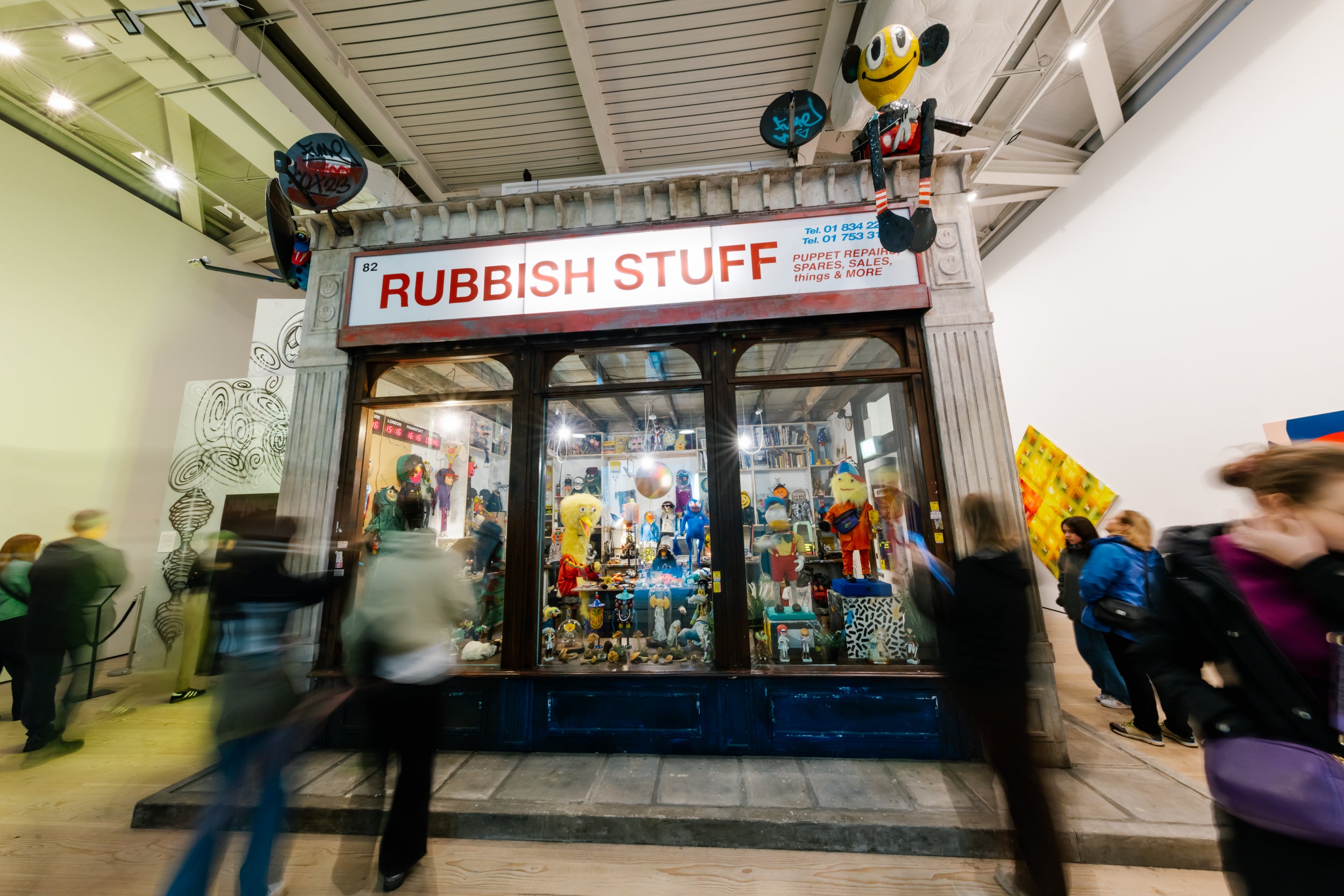


The Streets are in Play
Graffiti is not only an act of rebellion; it's inherently playful. A chance encounter with a stencil on the side of a building, a mural on a construction barrier or a scrawled poem on a random door can change our perceptions of life’s daily routines, where art placed in new contexts can amplify personal experiences and shift perspectives. Graffiti and street art encourage us to reevaluate the aesthetics and frameworks of the environments and systems we live in. For the artist, the streets are a constant source of inspiration, a studio in a public forum where all materials, surfaces and context inform one another, literally in play. Paul Insect creates a life-sized puppet show from found objects on the street; Maya Hayuk becomes inspired by her Ukrainian heritage and creates abstracted patterns from folk art; and Kenny Scharf takes the magic of the NYC club scene of the 1970s and 80s and reimagines it in a cave of psychedelic nostalgia. These are all exuberant, if not a little mischievous, reimaginings of how an artist can transform space and materials, in both a physical and personal sense. Paul’s work is an homage to the Fly Tip Theater project he created with his friend, BAST, a legendary NYC graffiti artist in his own right, who passed away in 2021. Scharf’s Cosmic Cavern is a re-establishment of a time and place, an immersive time travel experience, back to an era where he and his friends began to take over NYC with their own brand of artistic expression. In the centre of the room is Hayuk’s Four Letter Word, slang so commonplace and yet versatile in its use as a noun and a verb, used as an affirmation, confirmation, defamation and interjection. It causes a pause, a laugh, an understanding that life and art can be dichotomous and universally adventurous. This piece was originally painted at Beyond The Streets, Los Angeles in 2018, where Hayuk spent late nights painting alongside an installation of Jenny Holzer’s Truisms, where unexpectedly the work became a response to Holzer’s challenging words. Say the Four Letter Word, then take a left into the psychedelic reverie.

Glen E. Friedman
Photographer Glen E. Friedman has captured many greats of hip-hop, punk rock and skateboarding, working hard to centre himself in the subcultural spheres of both U.S. coasts. Friedman’s iconic work has graced the covers of many important albums from hip-hop’s golden era, including Beastie Boys, Run-DMC, Ice-T, Slick Rick, LL Cool J and others, making him the most prolific Def Jam photographer of the time. He continues to contribute to the cultures he has long photographed with an auteur’s eye through his books and documentary film work. His photographs here of Public Enemy are some of his most iconic, capturing a group at the height of their powers.


Traces of the City
Street art is about reimagining public space, changing the experience of daily life, interjecting a sense of individuality amongst the visual pollution of advertising and city planning. VHILS is a prominent voice in taking existing infrastructure and materials to recreate visuals that speak to a city’s residents and history. By repurposing billboards to create grand collaged portraits, VHILS responds to what he calls, the “erosion of cultural uniqueness in the face of the dominant model of globalised development, and the increasingly uniform reality it has been imposing around the world.” A method VHILS uses is to find billboards from the particular city he is exhibiting in. The materials here were sourced throughout London for Saatchi Gallery.

Street Art to Studio
Where Shepard Fairey and FAILE collide is the international scope of their notoriety. These American artists are key figures in the rise of the global street art movement, both transforming a love of pop iconography, poster art, skateboard graphics and anti-authoritarian messages into multimedia fine art practices. Their transitions from street to studio artists in the late 1990s and early 2000s brought about a complete shift in how street art and graffiti could be displayed in galleries and streets around the world.